
Thinking about investing and worried about protection

Rehobot our smartbotAccording to the FCA, regulated advice includes any communication with the customer which, in the context in which it is given, goes beyond the mere provision of information and is objectively likely to influence the customer’s decision whether to take an action, buy or sell. In a world full of bad actors, the challenge is ensuring you are informed and understand the level of protection you receive when you receive advice from a regulated adviser.

There are three levels of protection.
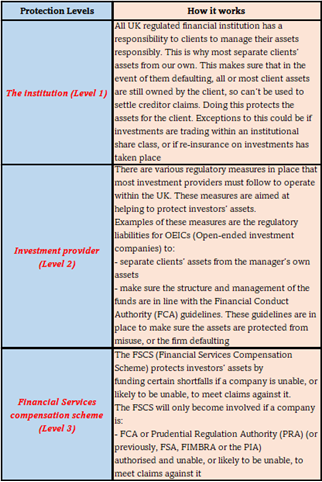
Three level of protection for investors

Investment provider or fund manager

With many investments, the legal structure required to manage the investment ensures greater protection of clients’ assets, such is the case with collectives that operate in line with the Financial Service and Markets Act 2000 (FSMA). Collective fund schemes have a responsibility to appoint a depositary who is independent to the fund’s board or the fund’s authorised corporate director. The depositary is responsible for ensuring the assets are segregated from the fund manager’s own assets and oversees the safe custody of these assets.

Unit trusts appoint a trustee who has similar responsibilities to that of a depositary for a collective and who’s responsible for ensuring the fund manager keeps to the fund’s investment objective and safeguards the trust’s assets.

The Financial Service compensation scheme

The FSCS is an independent body set up under the FSMA. The FSCS deals with claims against authorised firms regulated by the FCA or PRA. This usually happens because a firm has stopped trading and doesn’t have enough assets to meet claims or is in insolvency. This is described as in default. The primary role of the FSCS is to protect policyholders. They work with insolvency practitioners, responsible for the ongoing administration of the firm and the settlement of claims, to determine their involvement to make sure that policyholders have clear instructions on how to make a claim, and what to do if they need immediate assistance.

  • The FSCS can also provide funds to meet protected claims. This can include returning premiums if a firm is unable to. In some cases, funds from the insolvent firm may be available to pay some of the amount due to a client. If the amount paid is less than the FSCS compensation limit, then the client can make a claim on the FSCS for compensation for the balance in line with the FSCS compensation rules.
  • The FSCS can also try to arrange (or help with) a transfer of some of the business to other providers if this is cost effective and practical.

Who can claim?

The table below provides a summary of who can make a claim. Overseas financial services institutions and large companies can’t make claims.
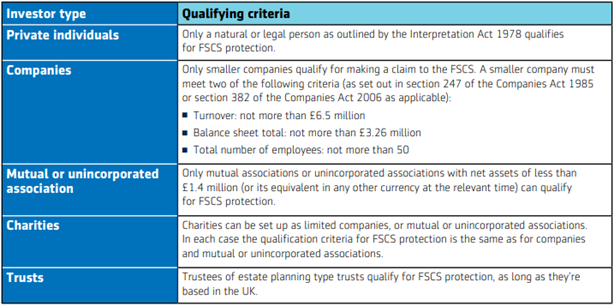
Qualifying criteria for protection

The full details of eligible parties to compensation can be found at https://www.handbook.fca.org.uk/handbook/COMP.pdf


I need some help with

Show more options

What Kind of assets do you own?

Select all that apply

Cash Savings

Most people underestimate what they have so it's important to spend a bit of time taking stock. It helps us match you to the right adviser

Pensions

Most people underestimate what they have so it's important to spend a bit of time taking stock. It helps us match you to the right adviser

Stocks, Shares, & Funds

Most people underestimate what they have so it's important to spend a bit of time taking stock. It helps us match you to the right adviser

Investment Properties

Most people underestimate what they have so it's important to spend a bit of time taking stock. It helps us match you to the right adviser

One final Step to getting the help you need

We will email you when we have found your financial adviser.
Cookie Policy

Cookie Policy

Most websites you visit will use cookies in order to improve your user experience by enabling that website to ‘remember’ you, either for the duration of your visit (using a ‘session cookie’) or for repeat visits (using a ‘persistent cookie’).
Some websites will also use cookies to enable them to target their advertising or marketing messages based, for example, on your location and/or browsing habits. Cookies may be set by the website you are visiting (‘first party cookies’) or they may be set by other websites who run content on the page you are viewing (‘third party cookies’).

What is in a cookie?

A cookie is a simple text file that is stored on your computer or mobile device by a website’s server and only that server will be able to retrieve or read the contents of that cookie. Each cookie is unique to your web browser. It will contain some anonymous information such as a unique identifier and the site name and some digits and numbers. It allows a website to remember things like your preferences or what’s in your shopping basket.

Accepting or declining cookies

You can choose to accept or decline cookies. Most web browsers automatically accept cookies, but you can usually modify your browser setting to decline cookies if you prefer. This may prevent you from taking full advantage of the website.

The types of cookies we use

First party cookies
First party cookies are set by the website you are visiting, and they can only be read by that site.

Third party cookies

Third party cookies are set by a different organisation to the owner of the website you are visiting. For example, the website might use a third-party analytics company who will set their own cookie to perform this service. The website you are visiting may also contain content embedded from, for example YouTube or Flickr, and these sites may set their own cookies.
More significantly, a website might use a third-party advertising network to deliver targeted advertising on their website. These may also have the capability to track your browsing across different sites. It is important to note that advertising cookies are not set for UK visitors to the rehowealth.co.uk website.
Rehowealth.co.uk  does use advertising cookies but these will not track your behaviour outside of the  rehowealth.co.uk website and other sites in our network.

Session cookies

Session Cookies are stored only temporarily during a browsing session and are deleted from the user’s device when the browser is closed.

Persistent cookies

This type of cookie is saved on your computer for a fixed period (usually a year or longer) and is not deleted when the browser is closed. Persistent cookies are used where we need to know who you are for more than one browsing session. For example, we use this type of cookie to store your preferences, so that they are remembered for the next visit.