Rehobotics: Understanding the UK state pension and retirement age changes.

State pension age UK


Life expectancy has increased over time and is projected to continue to do so. Life expectancy has increased by 10 years for male and females as of 2020 compared to 1951 according to the report provided by the office of National Statistic in Life tables and principal projection report.

There were 280 pensioners for every 1000 people of working age as of 2020. This will increase rapidly from the 2030s and will reach levels never seen before by 2070, where the ratio is projected to be 393 pensioners per 1,000 people of working age. in the light of the significant change in the UK economy in recent times and the impact on the public finances of heightened global volatility.
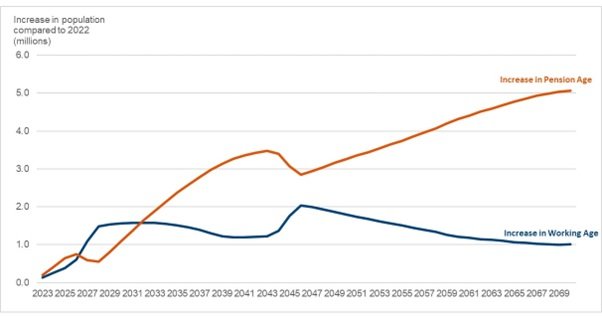
Increase in pension ages

It has now become important for each individual to begin the process of planning for their own retirement outside of the state support.

The current UK retirement age is 66 and will gradually start increasing again from 6th of May 2026
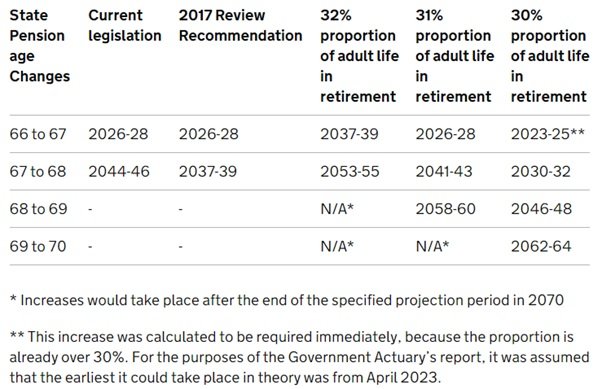
State pension age


Eligibility criteria

You’ll be able to claim the new State Pension if you’re:

  • A man born on or after 6 April 1951
  • A woman born on or after 6 April 1953

The earliest you can get the new State Pension is when you reach State Pension age.

Your National Insurance record

You’ll usually need at least 10 qualifying years on your National Insurance record to get any State Pension. They do not have to be 10 qualifying years in a row.

What you’ll get where you have the full contributory record

The full State Pension is £203.85 per week or £10,600 a year

You can get more than the full State Pension are if:

  • you have over a certain amount of Additional State Pension
  • you defer (delay) taking your State Pension

To check your forecast

Rehobot momentsCheck your State Pension forecast – GOV.UK (www.gov.uk)


I need some help with

Show more options

What Kind of assets do you own?

Select all that apply

Cash Savings

Most people underestimate what they have so it's important to spend a bit of time taking stock. It helps us match you to the right adviser

Pensions

Most people underestimate what they have so it's important to spend a bit of time taking stock. It helps us match you to the right adviser

Stocks, Shares, & Funds

Most people underestimate what they have so it's important to spend a bit of time taking stock. It helps us match you to the right adviser

Investment Properties

Most people underestimate what they have so it's important to spend a bit of time taking stock. It helps us match you to the right adviser

One final Step to getting the help you need

We will email you when we have found your financial adviser.
Cookie Policy

Cookie Policy

Most websites you visit will use cookies in order to improve your user experience by enabling that website to ‘remember’ you, either for the duration of your visit (using a ‘session cookie’) or for repeat visits (using a ‘persistent cookie’).
Some websites will also use cookies to enable them to target their advertising or marketing messages based, for example, on your location and/or browsing habits. Cookies may be set by the website you are visiting (‘first party cookies’) or they may be set by other websites who run content on the page you are viewing (‘third party cookies’).

What is in a cookie?

A cookie is a simple text file that is stored on your computer or mobile device by a website’s server and only that server will be able to retrieve or read the contents of that cookie. Each cookie is unique to your web browser. It will contain some anonymous information such as a unique identifier and the site name and some digits and numbers. It allows a website to remember things like your preferences or what’s in your shopping basket.

Accepting or declining cookies

You can choose to accept or decline cookies. Most web browsers automatically accept cookies, but you can usually modify your browser setting to decline cookies if you prefer. This may prevent you from taking full advantage of the website.

The types of cookies we use

First party cookies
First party cookies are set by the website you are visiting, and they can only be read by that site.

Third party cookies

Third party cookies are set by a different organisation to the owner of the website you are visiting. For example, the website might use a third-party analytics company who will set their own cookie to perform this service. The website you are visiting may also contain content embedded from, for example YouTube or Flickr, and these sites may set their own cookies.
More significantly, a website might use a third-party advertising network to deliver targeted advertising on their website. These may also have the capability to track your browsing across different sites. It is important to note that advertising cookies are not set for UK visitors to the rehowealth.co.uk website.
Rehowealth.co.uk  does use advertising cookies but these will not track your behaviour outside of the  rehowealth.co.uk website and other sites in our network.

Session cookies

Session Cookies are stored only temporarily during a browsing session and are deleted from the user’s device when the browser is closed.

Persistent cookies

This type of cookie is saved on your computer for a fixed period (usually a year or longer) and is not deleted when the browser is closed. Persistent cookies are used where we need to know who you are for more than one browsing session. For example, we use this type of cookie to store your preferences, so that they are remembered for the next visit.